
Material Guide
TPU vs. Silicone Exfoliating Gloves: A Buyer’s Material Selection Guide
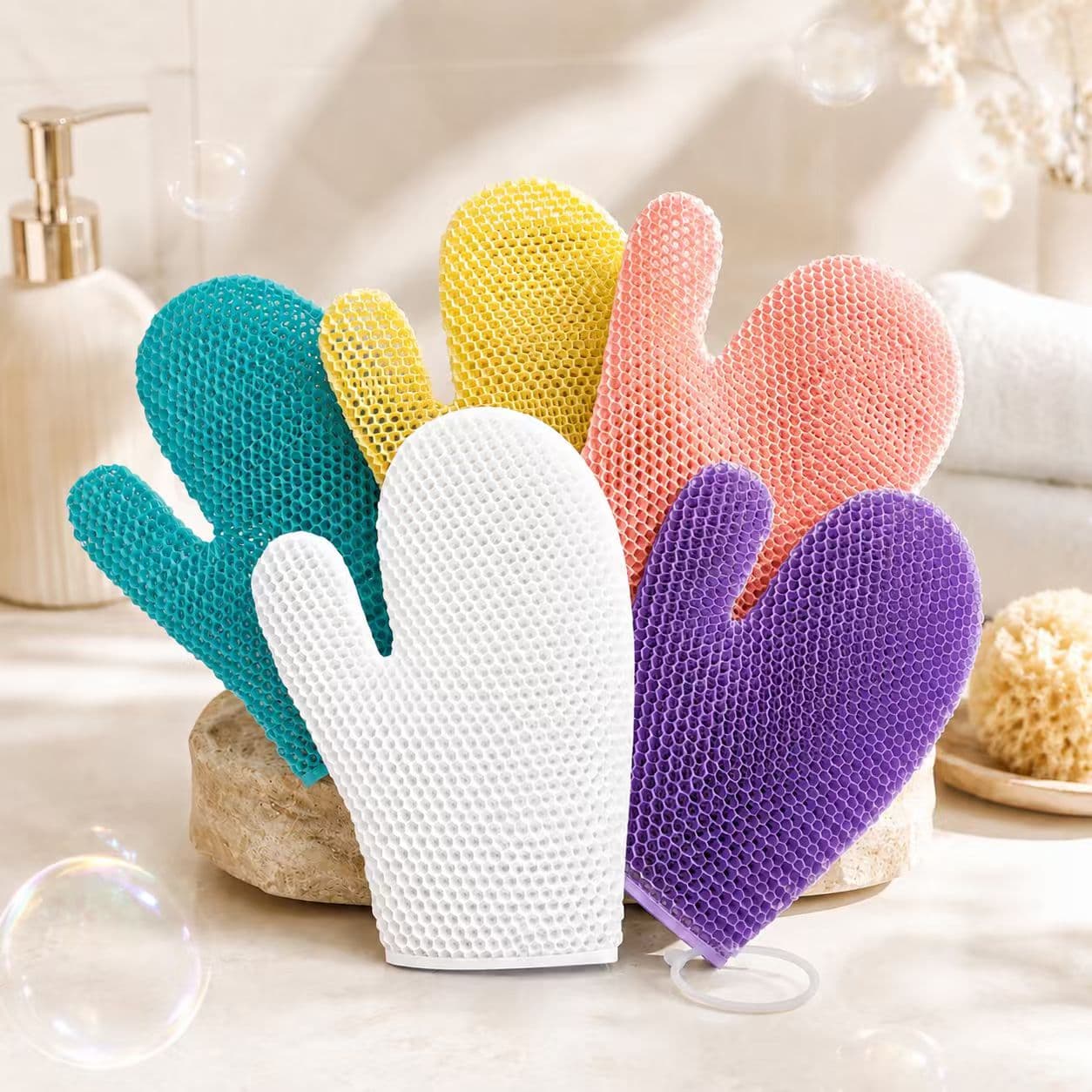
TPU and silicone can both be used to make reusable bath-care accessories, but they do not create the same product experience. For a brand buyer, the correct choice depends on the intended texture, product geometry, drying design, retail position, customization plan and evidence available from the supplier—not on a single claim such as “more hygienic” or “more durable.”
Choose TPU when your brief prioritizes a textile-like open structure, flexible elastic recovery, distinctive honeycomb texture and a lightweight glove or mitt format. Choose silicone when your concept requires a molded brush, dense flexible bristles or a solid one-piece scrubber. In either case, approve the finished design through physical samples and product-specific testing because resin-level properties alone do not predict finished-product performance.
What Are TPU and Silicone?
Thermoplastic polyurethane, usually shortened to TPU, is a family of elastomeric materials that combines flexible and rigid polymer segments. Commercial TPU grades can be formulated across a broad range of hardness, color, transparency and environmental resistance. BASF describes TPU as offering elasticity, flexibility, wear resistance and design freedom, while also noting that formulation, processing, moisture, part design and conditioning influence actual performance. That qualification matters for sourcing: a generic TPU data sheet is not a finished bath-glove test report.
Silicone is a different elastomer family. In bath accessories it is commonly compression-molded or injection-molded into solid scrubbers, flexible bristles, handles and one-piece shapes. Buyers often associate silicone with a smooth surface and molded detail. However, “silicone” also covers multiple formulations, hardness levels and processes, so the commercial name alone is not enough to specify feel, tear behavior or life span.
The practical distinction is structural. The HeySkins-type TPU glove uses an open honeycomb network that behaves more like a flexible mesh. A typical silicone bath brush uses molded projections on a comparatively solid base. Material and geometry work together, so compare complete product systems rather than isolated resin names.
TPU vs. Silicone: Buyer Comparison Table
| Decision factor | Open-structure TPU glove | Typical molded silicone scrubber |
|---|---|---|
| User experience | Flexible mesh-like glove with textured contact | Smooth molded base with bristles or nodules |
| Drainage concept | Water moves through open cells when rinsed and hung | Water drains from the surface; pockets depend on geometry |
| Product format | Thumb glove, mitt, sleeve, back scrubber | Brush, pad, strap or molded scrubber |
| Design route | Cut, formed or joined open-structure components | Tooling-driven molded geometry |
| Brand differentiation | Honeycomb texture, color, edging, loop and packaging | Bristle pattern, molded shape, color and packaging |
| Validation priority | Cell consistency, seams/joins, elastic recovery, edge finish | Molding consistency, bristle integrity, flash and tear points |
| Best fit | Brands seeking a lightweight textile-like bath accessory | Brands seeking a one-piece molded brush experience |
1. Texture and Exfoliation Experience
Mechanical exfoliation depends on surface texture, pressure, motion, skin condition and frequency of use. A product should therefore be positioned with careful, non-medical language. The American Academy of Dermatology advises that mechanical exfoliation is not appropriate for every skin type and recommends gentle pressure, short strokes and avoiding damaged or sunburned skin. A buyer should include responsible directions and avoid promising treatment of acne, keratosis pilaris or other conditions without suitable substantiation.
An open TPU glove can provide a defined, repeating texture with flexible movement around the hand. The perceived intensity will change with cell size, strand geometry, hardness, product thickness and how much pressure the user applies. A molded silicone scrubber typically creates contact through bristles or raised points; bristle length, taper, spacing and hardness control the feel.
During sample approval, do not rely only on a hand-feel impression from one person. Create a repeatable panel sheet: product code, sample date, dry feel, wet feel, grip, coverage, edge comfort, rinse behavior and observations after repeated use. This is not a clinical test, but it turns subjective feedback into a documented purchasing decision.
Comparing TPU samples for your product line?
Send your target market, preferred glove style, colors and estimated quantity. We’ll help you structure a sample comparison.
2. Drainage, Drying and Care Design
Open structure is one of the clearest reasons to evaluate TPU. When cells remain unobstructed, rinse water can pass through and the product exposes more surface to moving air when hung. That does not justify an automatic antibacterial or anti-mould claim. Drying depends on cell design, residual cleanser, ambient humidity, hanging position and user care. Claims about microbial growth require a defined method, test organism, laboratory report and wording that matches the test scope.
For silicone, evaluate whether the molded geometry traps water at the base of bristles, inside handles or around decorative features. A simple one-piece pad may rinse easily, while a hollow handle or deep pocket may retain water. The answer is design-specific rather than material-specific.
A useful buyer test is a controlled rinse-and-drain comparison. Apply the same amount of cleanser, rinse for the same time, hang products in the same environment and record mass or observable moisture at fixed intervals. Use the result internally unless the protocol and claims have been professionally validated.
3. Durability and Finished-Product Risk
TPU material suppliers commonly publish high elasticity, abrasion resistance and tear resistance for specific grades. Those properties make TPU attractive for flexible goods, but a glove can still fail at an edge, join, hanging loop or thin cell if design and processing are inconsistent. Inspect the entire construction.
For a TPU glove sample, check cell uniformity under transmitted light, flex the thumb junction, pull the hanging loop with a defined internal method, inspect edge finishing and compare dimensions across multiple pieces. After conditioning the sample in water and cleanser, repeat the visual and handling checks. Keep retained samples from the approved version so incoming or shipment inspection has a physical reference.
Silicone products have different risk points: incomplete fill, flashing, inconsistent bristle length, surface contamination, odor, tear initiation around holes and deformation after packaging. A high-quality molded product can be robust, but tooling and process control are essential. Ask the supplier how they control first-piece approval and lot consistency.
4. Customization, Tooling and Commercial Fit
TPU open-structure gloves often allow buyers to start with an existing product architecture and customize color, logo application, packaging and combinations. That route can reduce development complexity compared with a fully new structure. A unique geometry, material hardness or joining method may still require development work and a different MOQ.
Silicone is well suited to molded branding, custom bristle geometry and integrated handles, but a unique design normally depends more heavily on tooling. Buyers should clarify tooling ownership, maintenance, dimensional approval, revision cost and whether the mold can be used for other customers.
The right commercial route is not always the most customized route. For market validation, an existing structure with differentiated color and packaging can be more responsible than paying for tooling before demand is proven. For an established brand with clear volume and proprietary ergonomics, custom tooling may be justified.
5. How to Compare Supplier Samples
Request samples that represent the production method you intend to buy. A hand-prepared appearance sample may validate color or artwork but not production consistency. Label each sample as material sample, appearance sample, functional sample or pre-production sample, and record what is approved at each stage.
Your review checklist should cover product identity, dimensions, weight, material declaration, color under consistent lighting, odor, edge finish, surface defects, loop or handle, wet grip, rinse behavior, packaging fit, barcode position and master-carton protection. If the product will be sold with use or care claims, review those claims separately with your compliance adviser.
Before shipment, inspection should reference the signed specification and approved sample. Define the sampling approach, critical/major/minor defects and packaging checks in the purchase agreement rather than improvising after production.
Conclusion
TPU and silicone are not interchangeable labels for the same bath accessory. TPU is compelling when an open, textile-like, elastic glove structure supports the desired user experience and brand story. Silicone is compelling when molded bristles and a solid one-piece form better match the brief. Make the final decision through documented sample approval, responsible claims and supplier evidence—not assumptions about a material name.
Frequently Asked Questions
Is TPU better than silicone for exfoliating gloves?
Neither material is universally better. TPU is often a better fit for an open honeycomb glove, while silicone is often better for a molded brush or pad. Evaluate the finished design.
Does a TPU bath glove dry faster?
An open-cell design can support drainage and air exposure, but drying also depends on geometry, humidity, cleanser residue and how the product is hung. Validate the finished sample.
Can TPU exfoliating gloves be private labeled?
Yes. Typical options include color selection, logo treatment and retail packaging. Feasibility and MOQ depend on the requested level of customization.
Can a supplier claim antibacterial performance?
Only when product-specific evidence supports the exact claim and test scope. Generic material statements are not enough.
What should buyers test before ordering?
Check construction consistency, wet feel, rinse behavior, elastic recovery, loop or seam integrity, packaging fit and comparison with the approved sample.
Ready to discuss your product?
Turn Your Requirements Into a Clear Sample Plan.
Share the product style, target market, customization, quantity and timing. We’ll help define the next step.Send Your RequirementsThis guide separates general material information from finished-product claims. Material properties should be verified for the selected grade and product design. Consumer exfoliation guidance should remain gentle and non-medical.
Google Search Central: AI features and your websiteBASF: Elastollan TPU material informationAmerican Academy of Dermatology: How to safely exfoliate